
How Luxury Agents Get Found When High-Net-Worth Buyers Ask ChatGPT
08/03/2026
This guest article offers a preview of the insights Andrew Hong will bring to Leaders in Luxury 2026. As founder of Tobe Agency, Andrew helps real estate professionals understand how emerging AI platforms are changing the way consumers discover and evaluate agents. His work includes the AI & Search Intelligence Blueprint, which measures visibility across tools such as ChatGPT, Gemini, Perplexity, and Google’s AI results. Institute members may also recognize him from the April 2026 webinar, Be the Luxury Agent AI Recommends.
_____________________________________________________________________________________
Picture the referral you never see. A wealth manager's client is relocating to Scottsdale. Ten years ago, she would have called a friend for an agent's name. Five years ago, she would have Googled "luxury real estate agent Scottsdale" and scrolled through a page of ads and portals.
This year? She opens ChatGPT and types: "I'm buying a home in the $4M range in Scottsdale. Who are the best luxury agents there, and how should I choose one?"
She gets a confident, well-organized answer with names, credentials, and reasoning. She never sees a results page. She never scrolls past your ad. If your name is in that answer, you are on the shortlist before you know the conversation happened. If it is not, no amount of reputation fixes it, because the conversation is already over.
This is the quiet shift happening in luxury real estate right now. AI search for real estate agents is no longer a fringe behavior. Your clients did not announce that they changed how they search. They just changed.
The Searches You Cannot See
The numbers say this plainly. 82% of Americans actively buying or selling now use AI for real estate insights, per Realtor.com's October 2025 research. Not 82% of all Americans. 82% of the people in the market right now. Your clients.
The platforms have moved with them. Zillow launched a ChatGPT app in October 2025. Redfin followed in February 2026. Google AI Overviews now appear on the majority of searches, above every organic link and every ad.
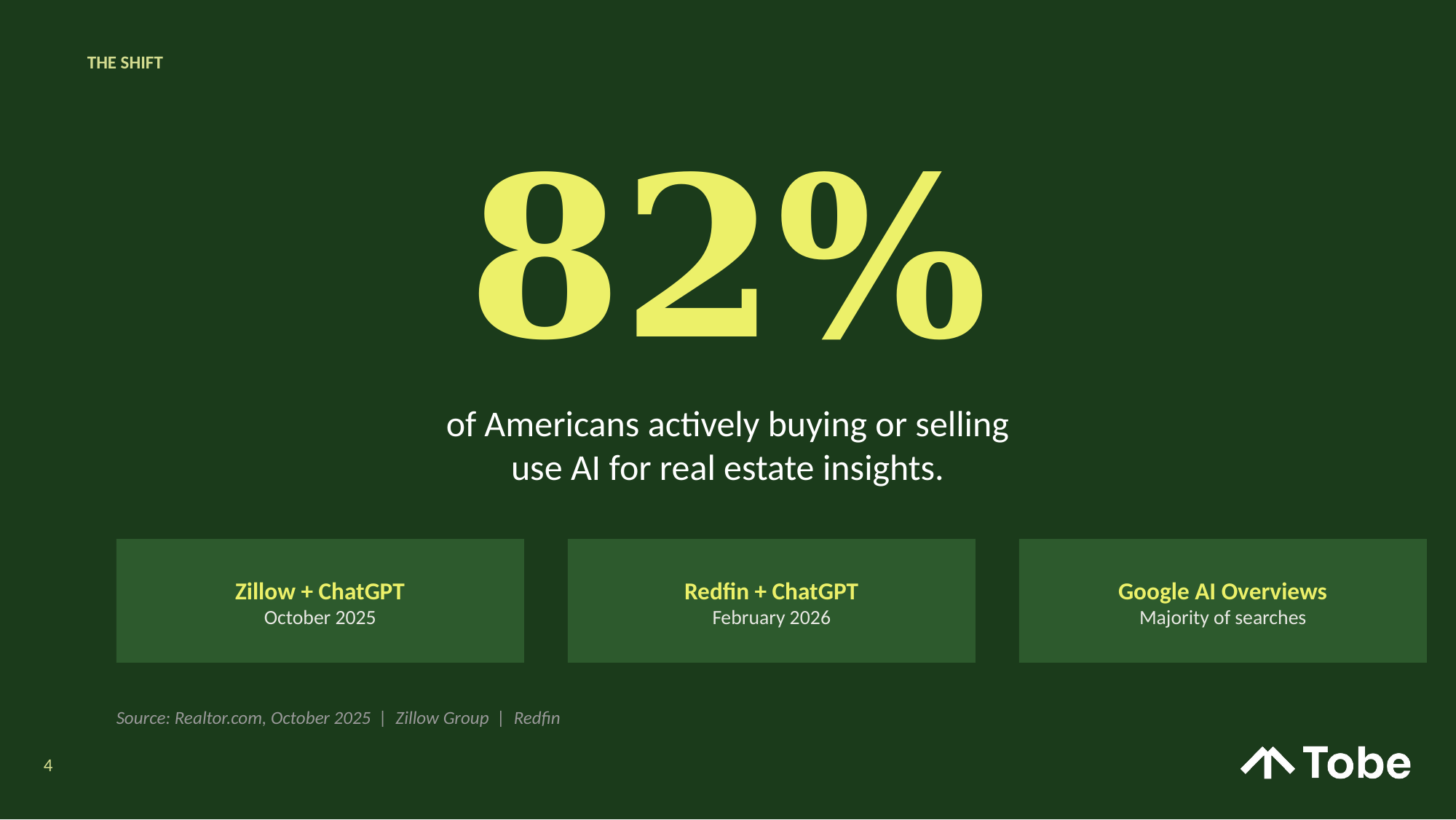
82% of active buyers and sellers now use AI for real estate insights. Source: Realtor.com, October 2025.
And the affluent client is the power user. 74% of households earning $100K or more use AI (Menlo Ventures, 2025), and the luxury buyer audience uses Perplexity 30.4% above the US average (SparkToro, March 2026).
These are the most self-researching consumers in existence. The idea that they would research their health, their portfolio, and their travel with AI, then skip it for a multimillion dollar transaction, is the part that does not add up.
At my agency, we track how AI platforms answer real estate questions every single day: the same questions, asked daily, across ChatGPT, Gemini, Perplexity, and Google's AI results. Two patterns show up consistently:
First, AI answers are winner-take-most.
- A traditional results page has ten blue links and three ads. There is room to be fifth and still get the click. An AI answer names three to five agents with a sentence of justification for each. There is no page two.
Second, the sources AI trusts are not the sources you would expect.
- When we analyzed which websites AI platforms pull from and cite on real estate questions, the industry's biggest institutions were nearly absent. Trade publications showed up. So did a long tail of small, specific, well-organized sites and blogs.
In our tracking data, individual agents with focused websites were cited more often than billion-dollar brands.
Read that again, because it is the most encouraging fact in this article. AI search does not rank by advertising budget or brand size. It cites whoever answers the question best.
That is an opening individual luxury agents have not had since the portals took over page one.
Name recognition is not recommendation
Here is the pattern in nearly every established agent we audit: the AI knows exactly who they are. Ask it directly and it can recite their brokerage, their market, sometimes their notable sales.
Then ask the question that actually matters, "who should I hire in this market," and they are nowhere in the answer.
One hundred percent name recognition. Near-zero recommendation.
We saw this at its starkest in an audit of an established luxury team, twenty-plus years in their market, with multiple marketing contractors all doing good work independently.
When we ran live queries, ChatGPT described this team as a "consulting firm." Gemini did not mention them at all. Perplexity returned no results. Only Claude had a partial match.
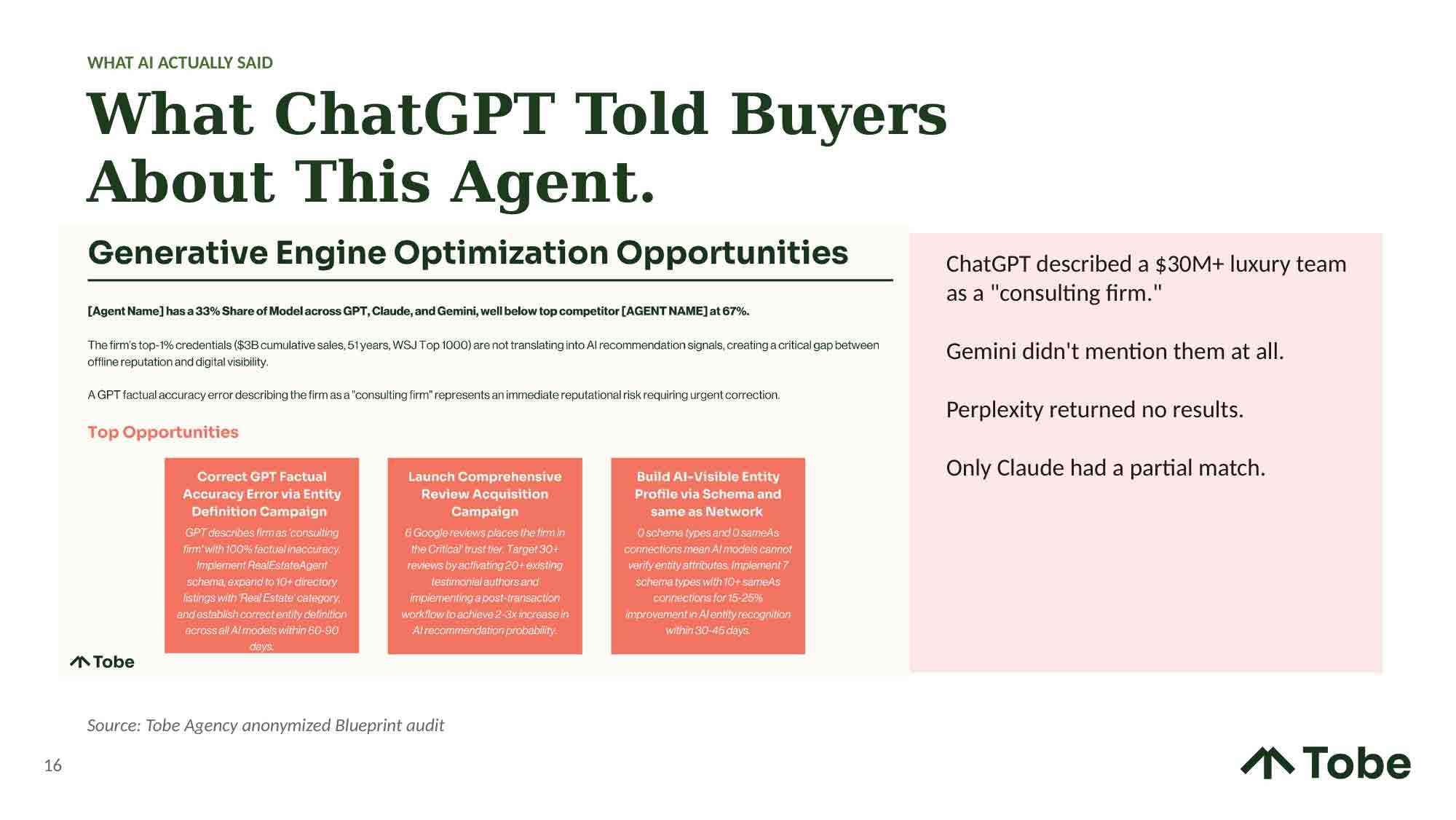
From an anonymized Blueprint audit: ChatGPT described an established luxury team as a "consulting firm."
The rest of the audit explained why. Visible on one of four AI platforms. Listed on four of the thirteen directories that matter. Eight Google reviews while their top competitor held forty-three. Fourteen months since their Google Business Profile was updated.
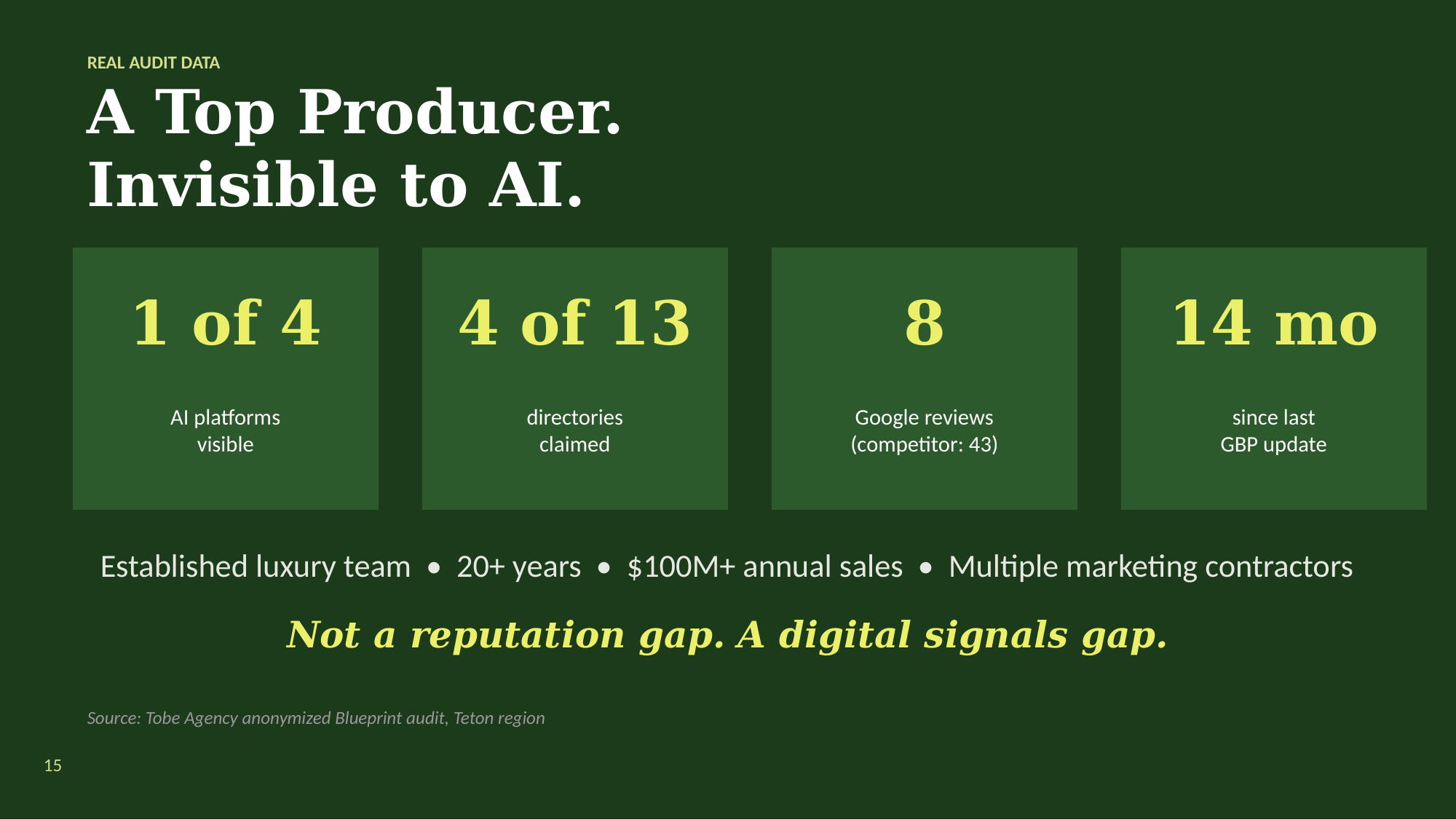
Not a reputation gap. A digital signals gap. Source: anonymized Tobe Agency Blueprint audit, Teton region.
This is not a reputation gap or a production gap. It is a digital signals gap. Twenty years of handshakes, closed deals, and whispered referrals built the business, but almost none of it left a footprint AI can read. The agents winning in AI search are not necessarily the best agents. They are the agents whose expertise is legible to a machine.
The Four Signals AI Checks Before It Recommends You
This discipline has a name, generative engine optimization, and it is to AI search what SEO was to Google. But you do not need the jargon. You need the four signals that tell Google and AI platforms who you are, what you do, and whether to recommend you.
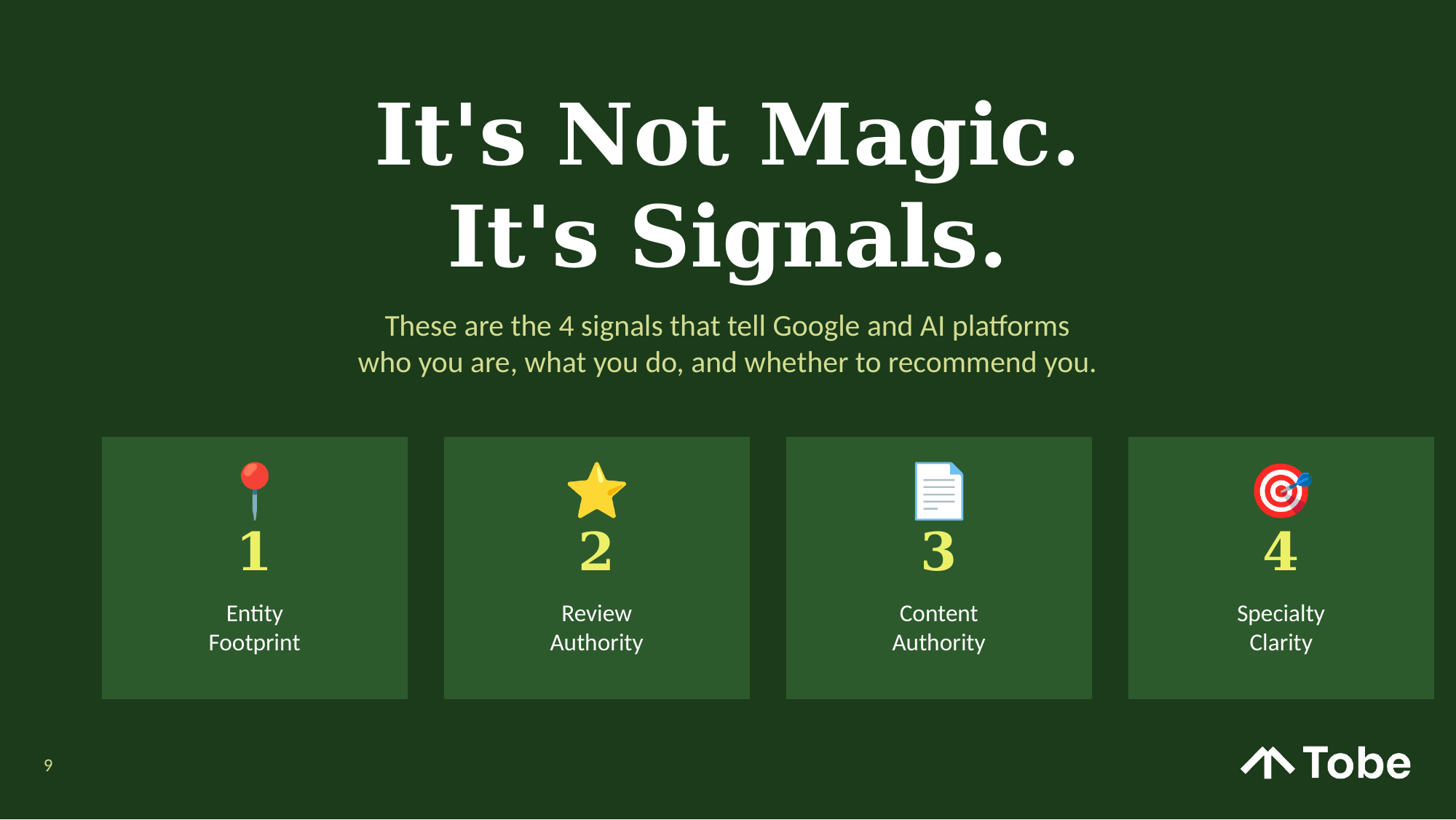
The four signals framework from the AI & Search Intelligence Blueprint.
Entity Footprint.
Before AI recommends you, it verifies you exist as a consistent entity. Your name, address, and phone number must match exactly across your website, Google Business Profile, Zillow, Realtor.com, and the rest. We check thirteen-plus directories in every audit; most agents are listed on four to six. A maiden name on one profile or an old phone number on another reads as unreliable, and unreliable does not get recommended.
Review Authority.
AI uses review volume and recency as a trust signal. In our audits, thirty or more Google reviews puts you in recommendation consideration for most luxury markets; below ten, you are effectively invisible in competitive ones. For listing agents, seller testimonials carry extra weight because they signal transaction volume on the sell side.
Content Authority.
AI recommends agents who have demonstrated expertise through content: market reports, neighborhood guides, seller resources, the questions your clients ask answered plainly on your site. A bio and a listings widget give AI nothing to work with. And Institute members are sitting on an unfair advantage here: the luxury market reports you already receive. A PDF is invisible to AI, but that same data published as searchable pages on your website, with proper markup, is one of the fastest ways to build content authority. You already have the source material.
Specialty Clarity.
"Real estate agent" is too generic for AI to recommend for anything specific.
Waterfront. Ranch. Second home. Listing specialist. Golf course communities.
Your specialty must appear consistently across your site, your profiles, and your bios. Remember: AI recommends the clearest signal, not the highest producer.
This is also where credentials earn their keep. When AI explains why it recommends an agent, it reaches for verifiable markers of expertise.
A designation like CLHMS is exactly the kind of specific, checkable credential AI answers are built from. "A Certified Luxury Home Marketing Specialist with fifteen years in Palm Beach waterfront properties" gives the machine something concrete to say about you. "Great agent, works hard" does not.
Where to start: a 30-minute self-audit
Whether you do anything else this quarter, do this today. Search your name on Google, ChatGPT, and Gemini. Check your Google Business Profile phone number and website URL. Check when you last posted there. Count your Google reviews.
Then read what AI actually says about you and ask one question: is it accurate?
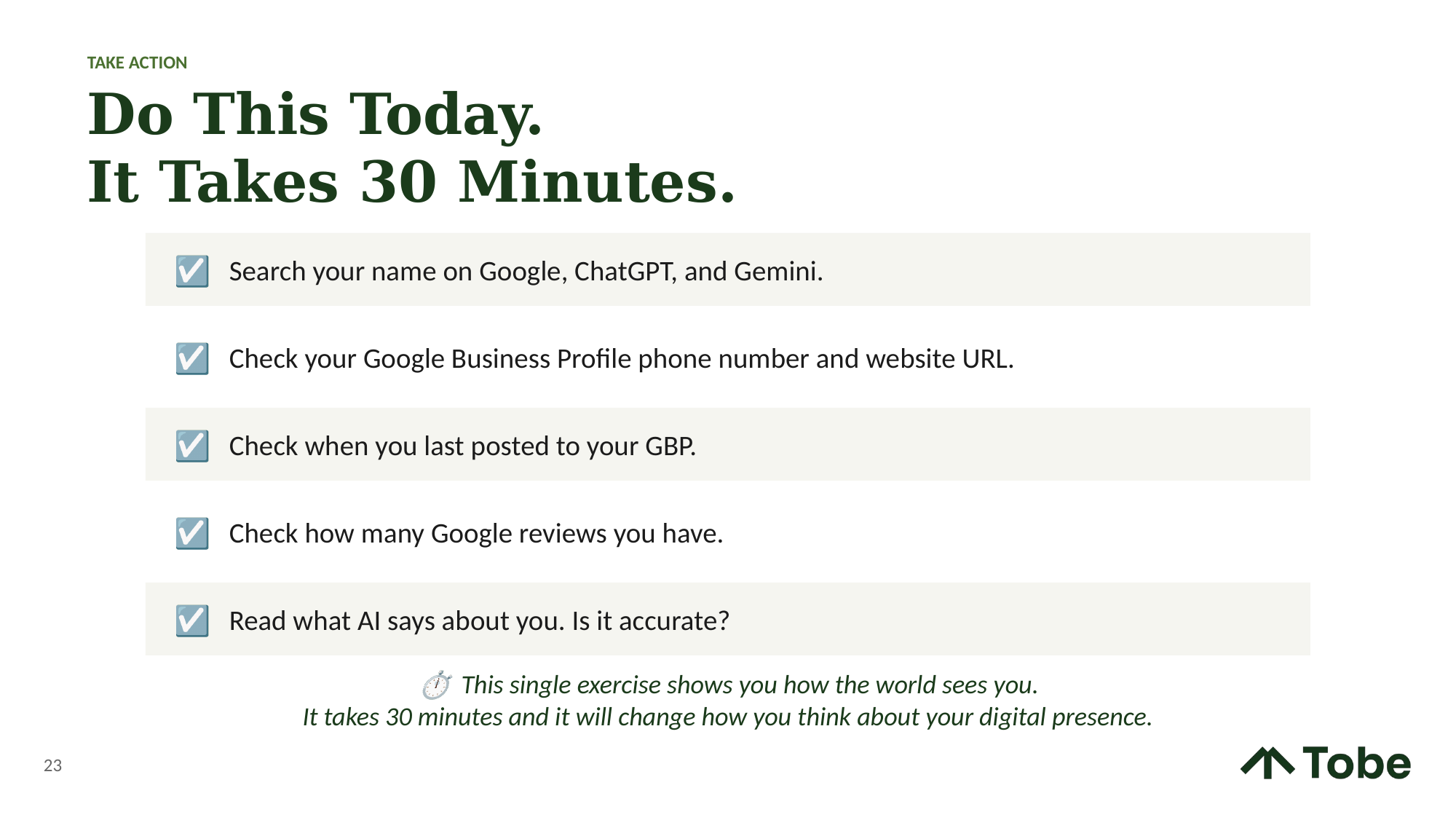
The 30-minute self-audit: five checks that show you how the world sees you right now.
That single exercise shows you how the world sees you. Then fix the gaps in order: consistency first, then reviews, then a written specialty, then one or two genuinely useful pages that answer real buyer and seller questions in your market.
The agents who took Google seriously in 2005 owned the next fifteen years of search. The same window is open right now with AI, and it will not stay open long, because these answers are being formed and reinforced every day. Your reputation took decades to build. Making it visible to AI takes a quarter of focused work. That is the highest-return marketing project available to a luxury agent in 2026, and almost nobody is doing it yet.
Want to know where you stand?
Download Tobe Agency's free Luxury Agent's AI Visibility Checklist, a 25-point self-assessment built on this signals framework, with specific guidance for referral-built businesses, brokerage-hosted sites, and dormant websites.
Andrew Hong is the founder of Tobe Agency, where he helps real estate professionals and small business owners get found in AI search and stop wasting money on marketing that no longer reaches buyers. He founded Tobe in 2016, has managed marketing for 100+ agents and brokerages, trained thousands of agents, and speaks regularly for the Institute for Luxury Home Marketing community. He is the creator of the AI & Search Intelligence Blueprint and host of the Grow Smarter podcast.